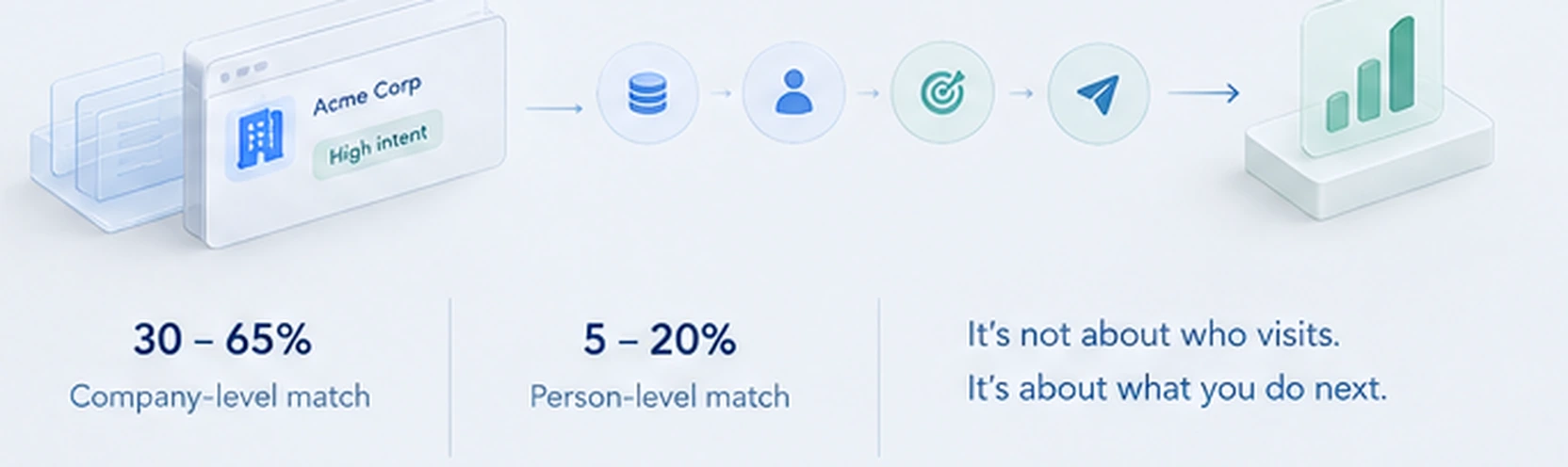
Most of the people who visit your site never tell you who they are. They read the pricing page, compare you to a competitor, and leave without filling a form. Website visitor identification promises to hand those names back to you, and it can, but two things are true that vendors tend to skip: the match rates are lower than the marketing claims, and identifying a visitor is the easy half. Acting on the match is where the money is, and where most teams stall.
Here is how the technology actually works, what it can realistically tell you, and how to turn a matched visit into pipeline instead of a dashboard nobody checks.
How visitor identification actually works
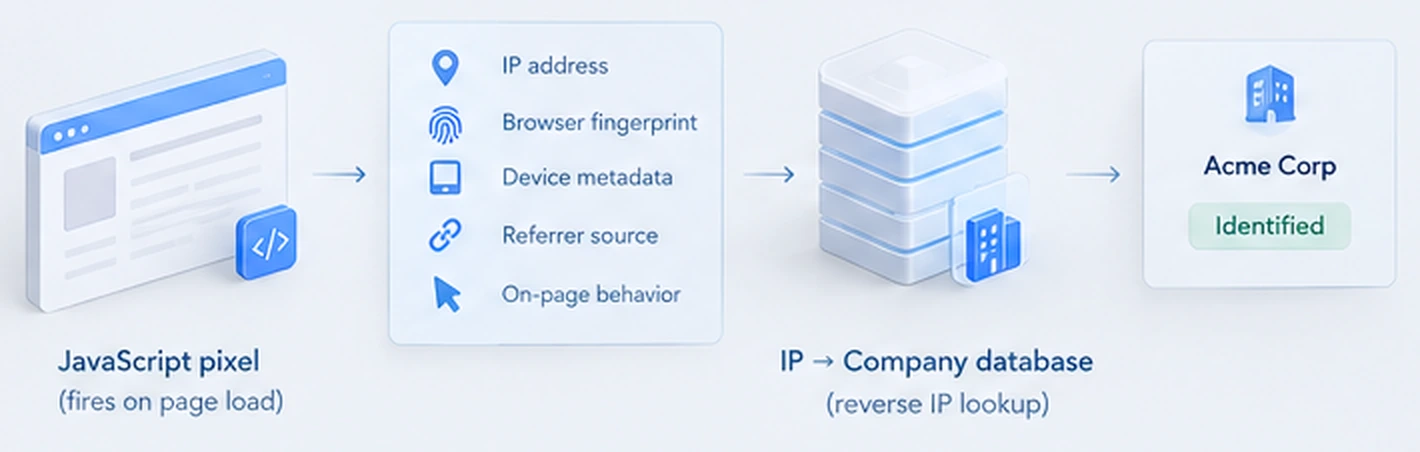
The mechanism is a lightweight JavaScript pixel that fires when a page loads. It collects the visitor’s IP address, browser fingerprint, device metadata, referral source, and on-page behavior. The IP is then run against commercial databases that map IP ranges to the companies that own or lease them. Match the IP to an organization and an anonymous session becomes a named company, no form required.
That last step is called reverse IP lookup, and it is the foundation of company-level identification. It is also where the honesty has to start, because it does not work on everyone.
The match rates nobody quotes you
Reverse IP resolves an office IP to a company. It does nothing for residential IPs, VPNs, and mobile connections, and in 2026 that is the majority of your traffic. So single-source reverse IP quietly misses most of your visitors, and any vendor quoting a 90% match rate is describing a lab, not your analytics.
Here are the numbers that hold up in independent testing:
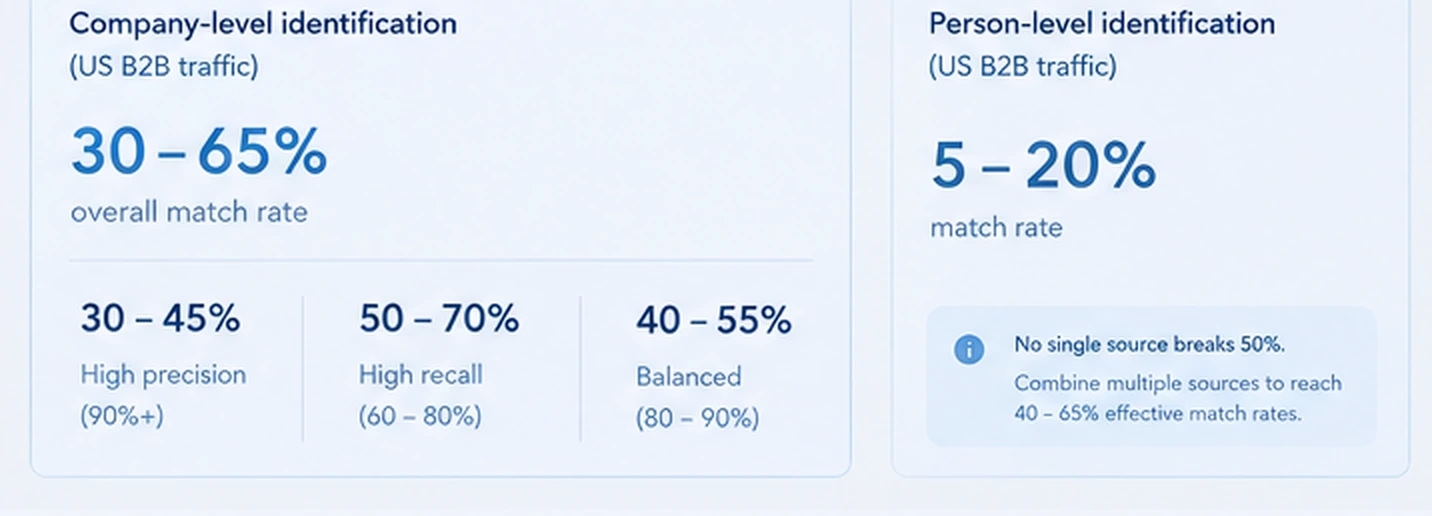
- Company-level identification lands at roughly 30 to 65% for US B2B traffic with a corporate buyer mix. Within that, high-precision vendors hit 30 to 45% at 90%+ precision, high-recall vendors reach 50 to 70% but at only 60 to 80% precision, and balanced vendors sit around 40 to 55% at 80 to 90% precision.
- Person-level identification, naming the actual individual rather than the company, reaches only 5 to 20% for the same traffic.
No single identification layer breaks 50%. The teams getting to an effective 40 to 65% do it by combining sources, not by finding one magic vendor. Anchor your expectations there, and treat any bigger promise as a reason to ask harder questions.
Company-level versus person-level, and the tradeoff
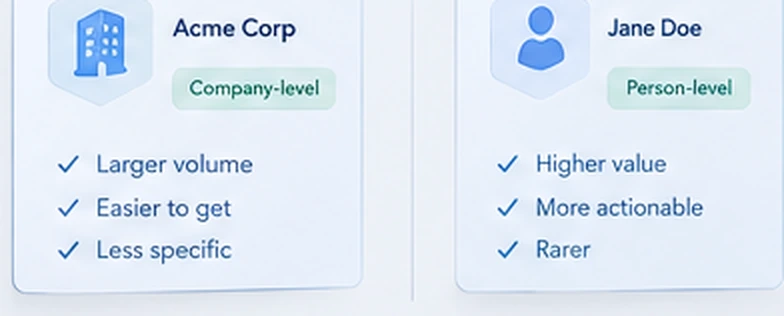
Company-level tells you Acme Corp was on your pricing page. Person-level tells you Jane, a VP at Acme, was. Person-level is obviously more actionable, and it is also far rarer, which is the whole tradeoff. Chase person-level and you identify a small slice at higher value. Accept company-level and you identify a larger slice you then have to work into a named contact yourself, usually with enrichment.
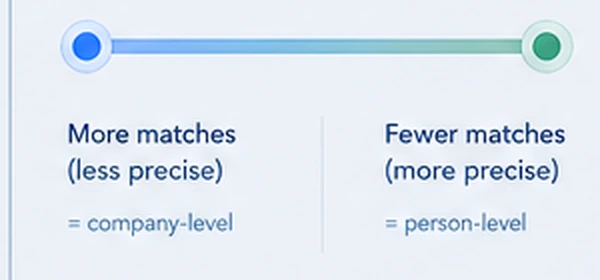
There is also a precision versus recall choice hiding in every vendor. High recall means more matches and more noise. High precision means fewer matches you can trust. Which one you want depends entirely on what happens next, which is the actual point of this whole exercise.
The tools, sorted by what you do after the match
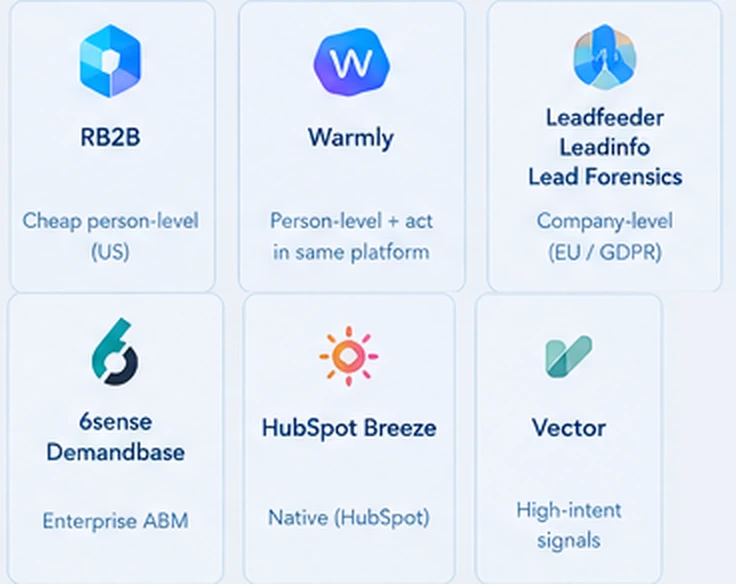
The best visitor identification software in 2026 is not the one with the biggest database, it is the one that fits what you do with a match. A quick map:
- RB2B wins for cheap person-level identification in the US.
- Warmly is built for teams that want person-level reveal plus the ability to act in the same platform, with intent signals, chat, and outbound orchestration bundled in.
- Leadfeeder, Leadinfo, and Lead Forensics are the picks for dependable company-level reveal with European and GDPR-compliant data.
- 6sense and Demandbase fit enterprise ABM budgets and motions.
- HubSpot Breeze is the native option if you already live in HubSpot.
- Vector leans into high-intent signals rather than raw identification.
We go tool by tool, with match rates and pricing, in best B2B website visitor identification software. But notice the pattern: every one of these is really chosen on the “what next” question, not the “who is it” question.
The part that actually decides ROI
A matched visit is a signal, not a lead. Acme Corp hitting your pricing page three times this week is a reason to reach out, but only if something happens with it in the next hour, not the next quarter. This is where most visitor-ID deployments die: the pixel fires, the dashboard fills up, and nobody works it.
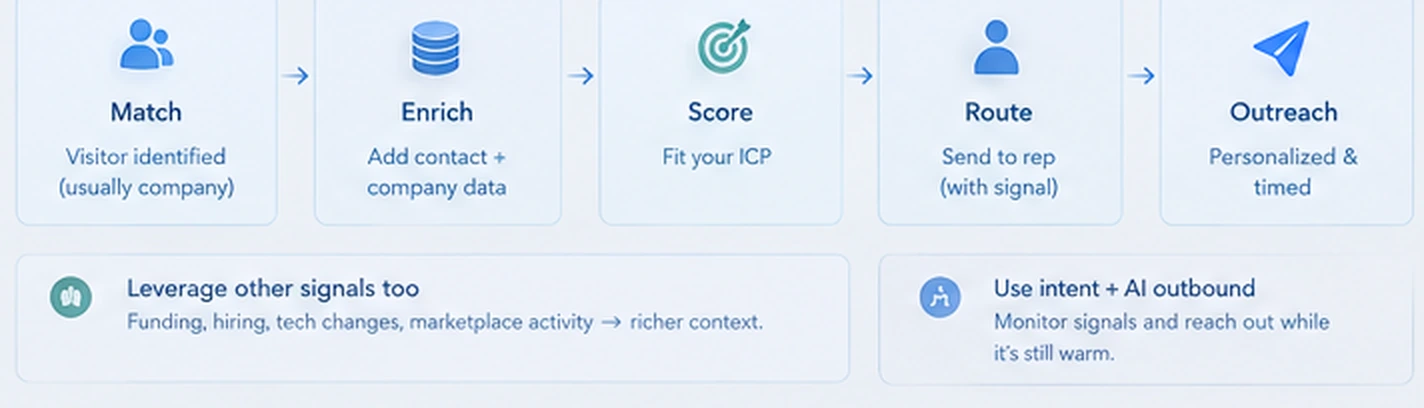
The system that makes visitor ID pay looks like this. A match fires, the record gets enriched into a real contact and company profile, it gets scored against your ICP, and if it clears the bar it gets routed to a rep with the signal attached, all automatically and fast. That routing engine is the same one that handles inbound signups, and we walk through building it in Clay enrichment and lead routing for free trials. The visit becomes one more high-quality signal feeding the same machine.
And a website visit is rarely the only signal worth watching. Funding, hiring, technology changes, and marketplace activity are all reasons to reach out at the right moment, which is the domain of intent data platforms. Wire visitor ID into that wider signal layer and each match gets richer context. Then the outreach itself has to be timed and personalized to the signal, which is what AI outbound sales motions are for. We build these signal-monitoring systems end to end, including an intent-monitoring build that watched a marketplace for buying signals.
The takeaway
Identifying anonymous website visitors is real, useful, and more limited than the ads suggest. Expect 30 to 65% at the company level and 5 to 20% at the person level, pick the tool by what you do after the match, and spend your real effort on the after. Identification is table stakes. The return comes from enriching, scoring, routing, and reaching out on the signal while it is still warm. That end-to-end build is what GTM engineering is, and it is the difference between a visitor-ID subscription and a visitor-ID system.
Sources:
- How it works (JS pixel captures IP, fingerprint, device, referral, behavior; IP matched to company databases; reverse IP resolves org): https://www.delivr.ai/resources/website-visitor-identification and https://abmatic.ai/blog/what-is-reverse-ip-lookup
- Reverse IP limits (residential/VPN/mobile don’t resolve, majority of 2026 traffic; single-source misses most): https://happierleads.com/blog/reverse-ip-lookup-accuracy-benchmark-2026 and https://www.unifygtm.com/explore/website-visitor-identification-how-it-works
- Match rates (company-level 30-65%, precision/recall tiers; person-level 5-20%; no single layer >50%; combination reaches 40-65%; 90% claims fail): https://www.warmly.ai/p/blog/visitor-identification-match-rates and https://www.factors.ai/blog/anonymous-website-visitor-identification-guide
- Tools by use case (RB2B cheap person-level US; Warmly reveal+act; Leadfeeder/Leadinfo/Lead Forensics company-level EU/GDPR; 6sense/Demandbase enterprise ABM; HubSpot Breeze native; Vector signals; best tool depends on what you do after): https://www.warmly.ai/p/blog/visitor-identification-software-top-11 and https://marketbetter.ai/blog/best-website-visitor-identification-tools-2026/