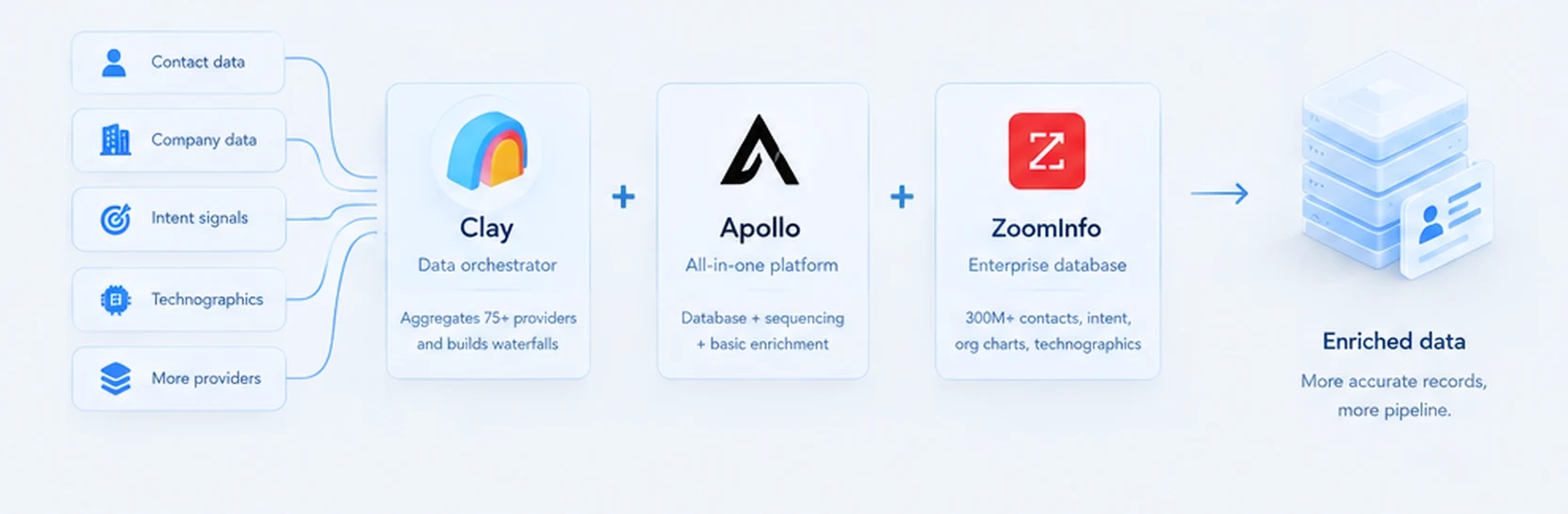
People compare Clay, Apollo, and ZoomInfo as if they are three versions of the same product. They are not even the same category. ZoomInfo is a database. Apollo is an all-in-one prospecting platform. Clay is a data orchestrator that connects to the other two and dozens more. Asking which is best is like asking whether a warehouse, a storefront, or a logistics network is best. It depends entirely on the job.
So this is not a winner-take-all verdict. It is a map of what each one actually is, the accuracy data that separates them, and the setup most serious teams end up running, which uses more than one.
Three tools, three categories
ZoomInfo is the database. It holds 300M+ contact profiles with intent data, org charts, and technographics, and it is built for depth and freshness at the account level.
Apollo is the all-in-one. Its 275M contacts and 73M companies sit inside a platform that also does sequencing and basic enrichment, so a team can prospect and send from one place, starting at a free tier.
Clay is the orchestrator. It does not maintain its own database. It aggregates, connecting 75+ enrichment providers through one interface so you can build waterfalls across them. Its accuracy tracks whichever providers a given waterfall hits, which is a feature, not a limitation, once you understand it.
Get that framing right and most of the confusion disappears.
The data head-to-head
Category aside, the numbers matter, and independent 2026 testing is clear on where each wins.
| Metric | ZoomInfo | Apollo | Clay |
|---|---|---|---|
| Direct-dial rate | 61% | 43% | weak (~30-35% mobile) |
| Mobile match | 67% | 41% | ~30-35% |
| Deliverable email | 92% | 88% (78% in one March test) | 85-92% via waterfall |
| Database | 300M+ contacts | 275M contacts, 73M companies | aggregates 75+ providers |
Two things to pull out. ZoomInfo genuinely leads on phone and mobile, which is why enterprise teams that live on the dial keep paying for it. And Clay’s email accuracy, at 85 to 92% through a waterfall, beats the 70 to 80% you get from any single provider, precisely because it checks a record against many sources instead of one. Clay’s weakness is phone, so it is not the tool to reach for when direct dials are the point.
When to use each
ZoomInfo earns its cost for enterprise revenue teams that need verified direct dials, org charts, intent signals, and tight Salesforce or HubSpot integration. If dials and account intelligence are your motion, its freshness and coverage justify the spend, and it is a real spend.
Apollo is the best all-in-one for early-stage SaaS. Prospecting database, email sequencing, and basic enrichment in one platform starting at $0 a month makes it the right pick for teams under about $1M ARR who need to move without stitching tools together.
Clay is the choice for GTM engineering. If you are building automated enrichment workflows and want programmatic control over which provider answers which record, its orchestration model is the whole point. It is less a data source than a way to run all your data sources as one system.
The setup most teams actually run
Here is the operator answer the versus-articles miss: mature teams do not pick one, they combine. A common and effective setup keeps ZoomInfo for its mobile numbers and intent signals, uses Apollo for high-volume list-building and sequencing at lower cost, and runs Clay as the orchestration layer that pulls from both, plus cheaper providers, in a waterfall.
That is exactly how we build it. Clay sits in the middle, ordering the waterfall so the cheapest reliable provider answers first and the expensive one only sees the records nothing else could. That ordering is what keeps the enrichment cost per valid record down while pushing accuracy up, and it is the same engine behind Clay enrichment and lead routing for inbound. Where all three sit in the broader stack is laid out in the GTM and sales intelligence tools teams actually use.
We have run this combined stack in production, including the enrichment system that screened more than 10,000 candidates a day across 120+ Fortune 500 roles. No single one of these tools would have carried that alone.
The takeaway
Do not ask whether Clay, Apollo, or ZoomInfo is best. Decide the job. ZoomInfo for enterprise dials and account intelligence, Apollo for all-in-one early-stage prospecting and sequencing, Clay for orchestrating many providers into one high-accuracy waterfall. And once you are past the earliest stage, expect to run a combination, with Clay as the join that makes the others work as a system. Designing that combination is a core part of GTM engineering, and it is the work we do.
Sources:
- Direct-dial and mobile accuracy (ZoomInfo 61% direct-dial, 67% mobile, 92% deliverable email; Apollo 43%/41%/88%, email match 78% March 2026; Clay ~30-35% mobile): https://www.cleanlist.ai/blog/2026-03-07-apollo-vs-zoominfo and https://www.devcommx.com/blogs/waterfall-enrichment-clay-vs-zoominfo-vs-apollo
- Databases (ZoomInfo 300M+ with intent/org charts/technographics; Apollo 275M contacts, 73M companies; Clay aggregates 75+ providers): https://prospectai.co/resources/blog/what-competitors-get-right and https://formanorden.com/blog/clay-vs-apollo-vs-zoominfo/
- Waterfall accuracy (85-92% email via waterfall vs 70-80% single provider): https://www.devcommx.com/blogs/waterfall-enrichment-clay-vs-zoominfo-vs-apollo
- When to use each (ZoomInfo enterprise dials/org charts/intent/CRM integration; Apollo all-in-one early-stage from $0, best under $1M ARR; Clay for GTM engineering / data orchestration, 75+ providers): https://formanorden.com/blog/clay-vs-apollo-vs-zoominfo/
- Combined setup (ZoomInfo for mobile + intent, Apollo for cheap volume + sequencing, Clay as orchestration): https://formanorden.com/blog/clay-vs-apollo-vs-zoominfo/ and https://prospectai.co/resources/blog/what-competitors-get-right