
The question people ask is “which sales intelligence tool is best.” It is the wrong question. No team wins on a single tool, and the ones that look like they do are quietly running four or five, wired together so each one feeds the next. The tool that matters is the system.
So this is not a ranked list of the one platform to rule them all. It is a map of the layers a modern go-to-market stack actually has, the real tools sitting in each layer, what they cost, and the part almost nobody gets right, which is how they connect.
The stack has layers, not a winner
A modern GTM stack in 2026 sorts into roughly five layers: data and intelligence, engagement, conversation, an AI agent layer, and measurement. Some teams slice it finer into six, splitting out CRM, GTM intelligence, data execution, sales engagement, marketing automation, and analytics. The labels vary. The shape does not: each layer does one job and hands its output to the next.
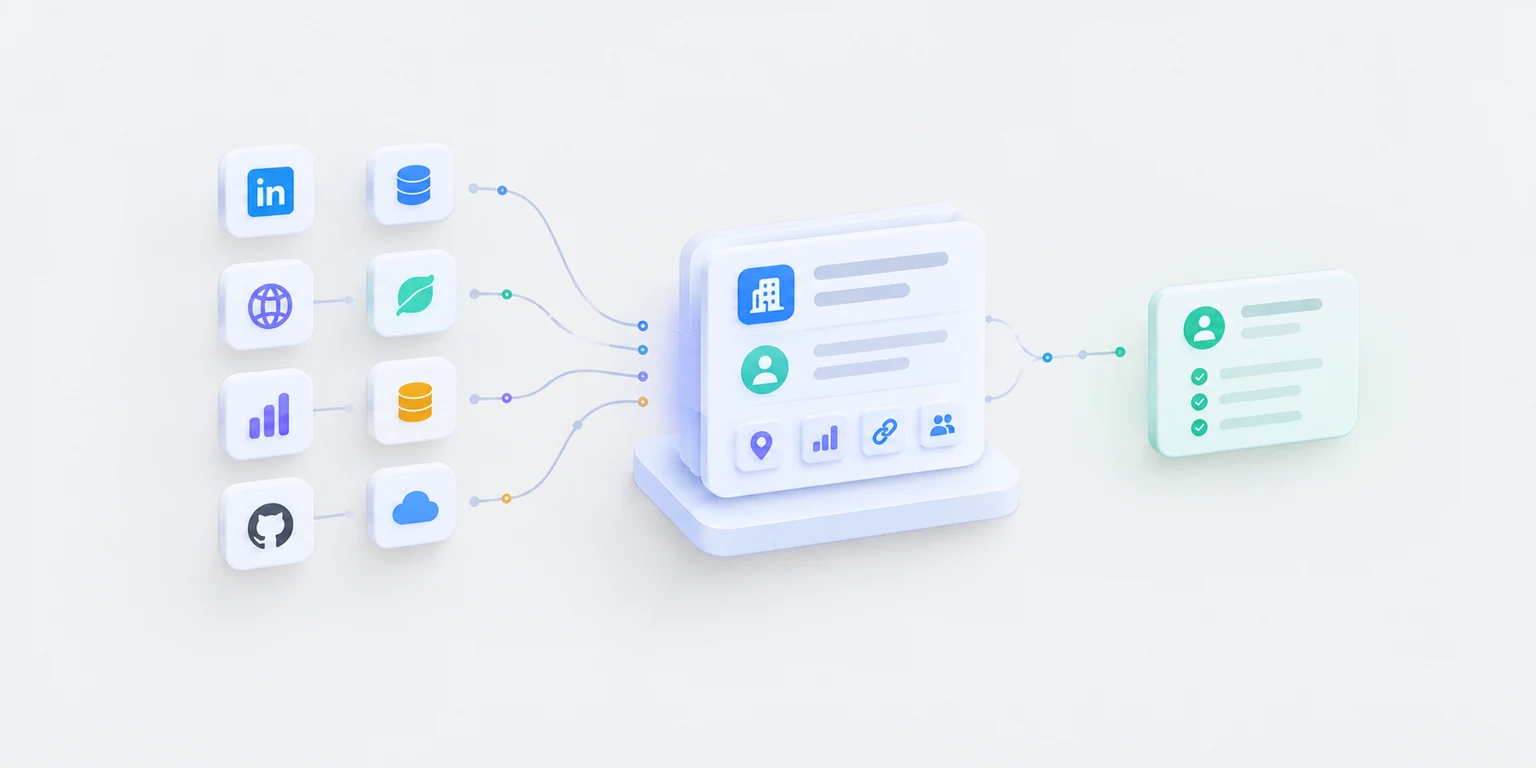
The layer worth calling out is the AI agent one, because it did not exist as a distinct category three years ago. These tools do not automate a single step in a workflow, they take a goal and produce finished output, operating more like a worker than a feature. Most stacks are only starting to add it, which makes it the layer where teams still have room to get ahead.
When people say “sales intelligence tools,” they almost always mean the first layer: the data. That is where the confusion lives, so that is where we will spend most of this.
The data and intelligence layer
This layer finds the right companies and people, then enriches those records with firmographics, technographics, funding data, and intent signals. Get an account’s size, industry, tech, and buying signals in one place and you have the picture you need to decide whether and when to reach out. Here are the tools teams actually run, and what each is genuinely for.
ZoomInfo is the enterprise default. It carries the largest B2B contact database, the deepest direct-dial coverage, and intent and technographic data, which is why enterprise sales teams live in it. The catch is cost and commitment: pricing is not public and the entry point is around $15,000 a year, so it is a serious line item, not a self-serve tool.
Apollo is the all-in-one for SMB and mid-market. It combines a 240M+ contact database with sequencing, dialers, inbound routing, and enrichment, claims 98% email accuracy, and starts at a transparent $49 per user per month. For a team that wants data and outreach in one place without an enterprise contract, it is the value pick.
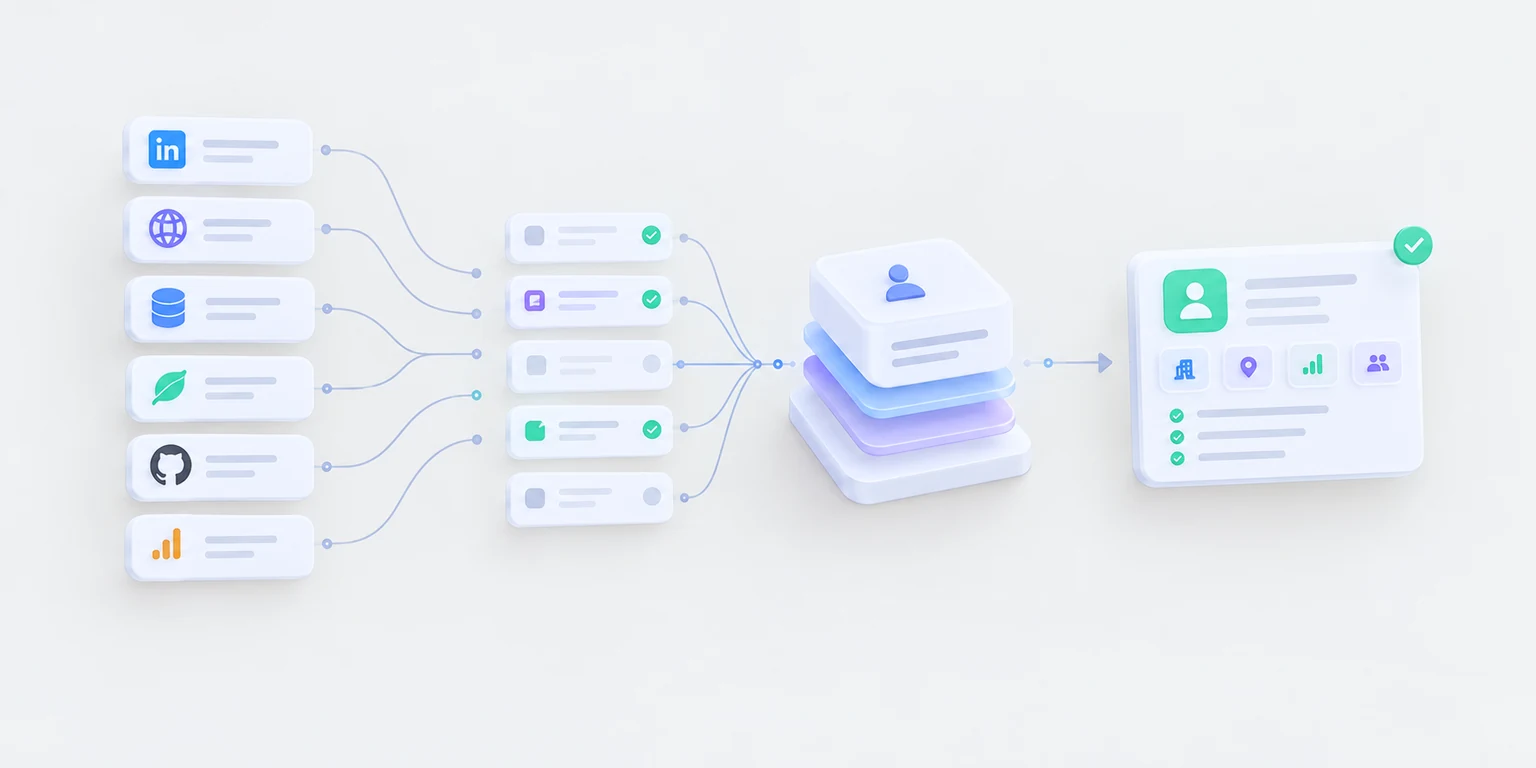
Clay is the different animal, and the one closest to how we work. Clay does not maintain its own database. Instead it connects to ZoomInfo, Apollo, LinkedIn, Clearbit, Hunter, and dozens of other providers and lets you build enrichment waterfalls across them, so a record gets checked against many sources and stops at the first good answer. That makes it more technical than a traditional tool, and it appeals to RevOps and growth-engineering teams that want programmatic control rather than a fixed database. We cover the head-to-head in Clay vs Apollo vs ZoomInfo.
Cognism is the pick when coverage has to be GDPR-compliant across Europe and global markets, which matters more than raw database size the moment your ICP sits outside the US.
Lusha is the SMB self-serve option, a browser extension for quick contact lookup, useful for light volume rather than a system of record.
Clearbit is now Breeze Intelligence. HubSpot acquired it in November 2023 and is folding it into HubSpot’s native AI enrichment layer, so if you live in HubSpot it is becoming the path-of-least-resistance enrichment, starting around $75 a month.
LinkedIn Sales Navigator sits slightly apart. At $119.99 a month for Core and $159.99 for Advanced, it is the best window into people and their activity inside the LinkedIn graph. Its real limitation is account-level intelligence: it does not track funding rounds, earnings calls, technology adoption, or leadership changes, the very signals that tell you when to reach out. It shows you who, not when.
A useful pattern from teams at scale: most run two tools here, one for prospecting like ZoomInfo or Apollo, and one for enrichment. What each of those data pulls actually costs, credit by credit, is its own rabbit hole, and we break it down in data enrichment API pricing.
The engagement layer
Once you know who to reach, the engagement layer runs the outreach. Enterprise teams lean on Outreach or Salesloft for multichannel sequencing and cadence management. Cold-email-first teams run dedicated senders like Instantly or Smartlead built for deliverability and volume. Apollo blurs the line by bundling sequencing into its data platform, which is part of its SMB appeal. The choice depends less on features than on whether outreach is your whole motion or one channel among several.
Conversation, agents, and measurement
The back half of the stack turns activity into learning. Gong and its peers record and analyze calls so the team can see what actually moves deals. The AI agent layer, the new one, takes goals like “research these accounts” or “draft first-touch messages” and returns finished work. And the measurement layer ties it together, turning deal execution into pipeline and evidence-based forecasts. Marketing automation, Marketo or HubSpot, feeds the top of all of it.
The part that actually decides the outcome
Here is the operator truth: the most important shift in 2026 is not any single tool, it is how the tools connect. The teams winning have every layer feeding the next, prospecting data flowing into engagement, engagement data flowing into deal execution, deal execution producing pipeline and forecasts. A best-in-class tool in every box, none of them talking to each other, loses to a modest stack that is wired as one system.
This is why we treat the stack as something you engineer, not something you buy. Clay usually sits at the center of the data layer for exactly this reason: because it orchestrates the other providers rather than replacing them, it becomes the join between “who to reach” and everything downstream. That orchestration mindset is the whole of what GTM engineering is, and it is how the same tools that give one team a cluttered dashboard give another team a pipeline. When you run these tools as one system rather than several subscriptions, the outbound built on top gets sharper too, which is the subject of AI outbound sales.
We have assembled and run stacks like this in production, including the system that screened more than 10,000 candidates a day across 120+ Fortune 500 roles. The tools in that build are named on this page. The reason it worked is that they were connected.

The takeaway
Do not shop for the best sales intelligence tool. Decide what each layer of your stack needs to do, pick the tool that does that one job well for your ICP and budget, and then spend your real effort on the connections between them. ZoomInfo, Apollo, Clay, Cognism, and the rest are all good at what they are for. The advantage was never owning the best one. It was wiring them into a system.
Sources:
- Modern GTM stack layers (data & intelligence, engagement, conversation, AI agents, measurement; six-category alternative; AI agent layer is new; integration is the key shift; representative stack): https://www.demanddrive.com/insight/the-gtm-tech-stack-of-2026-how-leading-teams-are-evolving/ and https://www.mutinyhq.com/faqs/what-is-the-modern-gtm-tech-stack-in-2026
- Sales intelligence layer purpose (find + enrich firmographics/technographics/funding/intent): https://pipeline.zoominfo.com/sales/gtm-tech-stack
- Leading platforms and roles (ZoomInfo enterprise/largest DB; Apollo SMB data+sequencing; Clay multi-source enrichment for RevOps; Cognism GDPR EU/global; Lusha SMB self-serve; teams run two, prospecting + enrichment): https://www.cleanlist.ai/blog/zoominfo-apollo-clearbit-data-provider-comparison-2026
- Apollo specs and pricing (240M+ contacts, 98% email accuracy, sequences/dialers/routing/enrichment, from $49/user/mo): https://www.apollo.io/insights/clearbit-alternatives
- ZoomInfo pricing (not public, ~$15,000/yr minimum) and Clearbit/Breeze (HubSpot acquisition Nov 2023, from ~$75/mo): https://www.cleanlist.ai/blog/zoominfo-apollo-clearbit-data-provider-comparison-2026 and https://www.default.com/post/zoominfo-competitors-and-alternatives
- Clay connects to ZoomInfo/Apollo/LinkedIn/Clearbit/Hunter and builds waterfalls, more technical, for RevOps/growth engineers: https://www.cleanlist.ai/blog/zoominfo-apollo-clearbit-data-provider-comparison-2026
- LinkedIn Sales Navigator pricing ($119.99 Core / $159.99 Advanced per month) and the buying-signal limitation: https://salesmotion.io/blog/linkedin-sales-navigator-pricing and https://www.factors.ai/blog/linkedin-sales-navigator-cost