AI outbound sales had its hype year, and the results are in. The version that got sold, an autonomous AI SDR you switch on and let run, has failed at a startling rate. Between 50 and 70% of teams that deployed AI SDRs churned off them within three months, 40 to 60% of pilots failed within 90 days, and only about 2% of full AI SDR implementations still stick long term.
That is not an argument against AI in outbound. It is an argument against one specific way of using it. Because at the same time, teams using AI to augment human sellers report 2.8x more pipeline than teams that tried to replace them. Same technology, opposite outcome. This is the distinction that decides whether AI outbound works for you, so it is worth understanding exactly where the line falls.
What “AI outbound sales” actually means
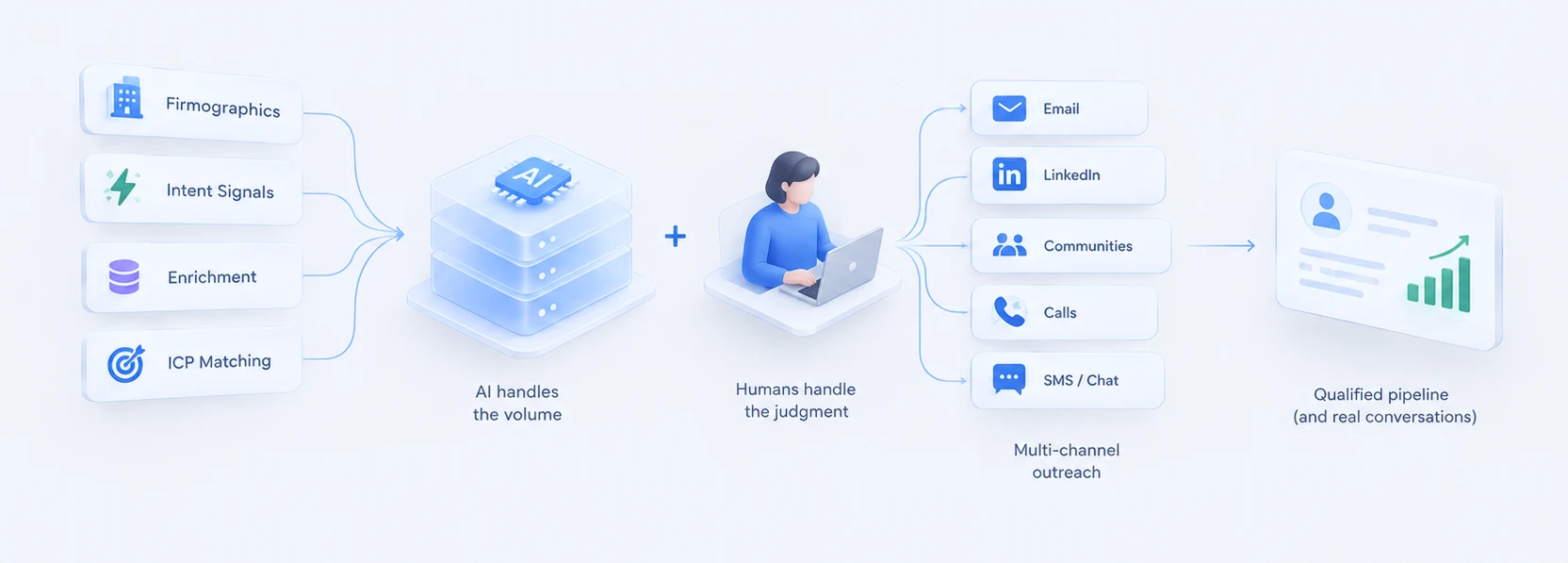
Strip the marketing and AI outbound is software that runs the proactive part of outreach: it builds a prospect list by matching your ICP against firmographic data and early intent signals, researches each prospect against that ICP, generates personalized messages, executes multi-channel sequences, watches for engagement, and passes qualified prospects to a human with the full context already in the CRM.
Notice what that list is: it is the volume-dependent, repetitive work. Finding, researching, drafting, scheduling follow-ups. None of it is the judgment work, and that separation is the whole story.
The 2026 reckoning
The failures were not random. The autonomous deployments died from a short list of causes: poor targeting, deliverability collapse, and compliance violations. Let a fully autonomous bot run outbound for weeks with nobody reviewing who it targets, what it sends, or the health of its sending domains, and it degrades. It sprays a weak list, the complaint rate climbs, the domain reputation craters, and the mailbox providers start rejecting the mail. By the time anyone notices, the damage is done.
There is a deeper reason too. Superficial personalization, the kind a bot generates at volume, is now detectable both by buyers and by the mailbox providers, whose spam filters increasingly use AI signals of their own. Average reply rates have fallen from 8.5% in 2019 to 3.4% in 2026, and unsupervised AI has accelerated that decline rather than reversed it. More volume of the same detectable pattern makes the pattern easier to filter, not harder.
What actually works: AI-augmented humans
The winning model in 2026 is a hybrid, and the split is clean. AI handles the volume: prospecting, first-draft messaging, follow-up scheduling, signal monitoring. Humans handle the judgment: qualifying responses, steering targeting, owning relationships, and auditing what the system is doing.
The human-in-the-loop part is not optional garnish, it is the mechanism that keeps performance from decaying. Someone has to constantly audit, refine, and steer the AI, or the same drift that killed the autonomous deployments sets in. The teams getting 2.8x the pipeline are not the ones with the most autonomous tool. They are the ones who put AI on the volume and kept a human on the wheel.
Where the tools actually fit
Part of the confusion is that very different tools get lumped under “AI outbound,” so here is the map:
- Autonomous AI SDRs like 11x and Artisan are the ones that promise a full digital worker. 11x’s Alice runs end-to-end prospecting and outreach, positioned as an SDR replacement. These are the most prominent autonomous options, and independent reviews are blunt that they carry real limits in data, deliverability, and channel coverage. They are the category with the churn problem above.
- Clay is not an AI SDR, and it is worth being clear about this. It does not send emails, manage sequences, run deliverability, or monitor buying signals in real time. It is a research and enrichment engine that feeds the other tools. Treating it as the “AI” that does outbound is a category error. It is the data layer, and a very good one, which is why it sits at the center of the GTM and sales intelligence stack.
- Sending and sequencing tools like Instantly, Smartlead, and Apollo are the execution layer that actually delivers the mail. We compare them in Instantly alternatives.
An AI outbound motion is these layers wired together, with a human steering, not any single product doing everything.
The two things that decide the outcome
Under all of it sit the same two levers that decide every outbound motion, AI or not.
First, signal. The reason full autonomy sprays and fails is that it is not anchored to a real, timely reason to reach out. Signal-based outbound, tied to something that actually happened at the account, is what separates a 5 to 18% reply rate from a 1 to 3% one, and it is exactly the judgment layer a human keeps sharp. We break down how signal drives reply rates in cold email sequences that get replies. Feeding good enrichment into that, at a cost you control, is its own discipline, covered in data enrichment API pricing.
Second, deliverability. The fastest way an AI outbound program dies is a reputation collapse nobody was watching. In 2026 that is fatal, because failed authentication now means rejection, not the spam folder. This has to be a monitored system, which we cover in cold email deliverability in 2026.
We build AI outbound this way in production, AI on the volume and a human on the judgment, including a system that monitored a marketplace for buying signals and turned them into outreach.
The takeaway
AI outbound sales is real and it works, but not as a robot you switch on. The autonomous-replacement version failed in the market, hard. The version that produces 2.8x the pipeline puts AI on the repetitive volume, keeps a human steering targeting and quality, anchors every message to a real signal, and treats deliverability as a monitored system. That is not a tool you buy. It is a system you engineer, which is what GTM engineering means, and it is what we build.
Sources:
- Definition and process of AI outbound / AI sales agents (find, research, personalize, multi-channel, monitor, hand qualified to human): https://www.cirrusinsight.com/blog/ai-outbound-sales and https://aircall.io/blog/ai-sales-agent-guide/
- AI SDR backlash (50-70% churned within 3 months; 40-60% of pilots fail within 90 days from targeting/deliverability/compliance; only ~2% of full implementations stick): https://www.usergems.com/blog/are-ai-sdrs-worth-it and https://www.apollo.io/insights/what-are-the-limitations-of-current-ai-sdr-tools
- AI-augmented humans report 2.8x more pipeline than full-replacement; human-in-the-loop required to prevent degradation: https://www.usergems.com/blog/are-ai-sdrs-worth-it and https://salesmotion.io/blog/ai-sdrs-vs-human-sdrs
- Hybrid model (AI on volume: prospecting, first-draft, follow-up scheduling; humans on judgment): https://www.cirrusinsight.com/blog/ai-outbound-sales
- Reply rates fell 8.5% (2019) to 3.4% (2026); superficial personalization detectable by buyers and spam filters: https://www.usergems.com/blog/are-ai-sdrs-worth-it
- 11x Alice/Julian as SDR replacement; Artisan and 11x most prominent autonomous options with limits in data/deliverability/channels; Clay is not an AI SDR (no sending, sequences, deliverability, or real-time signals): https://www.salesforge.ai/blog/outbound-ai-sales-agents