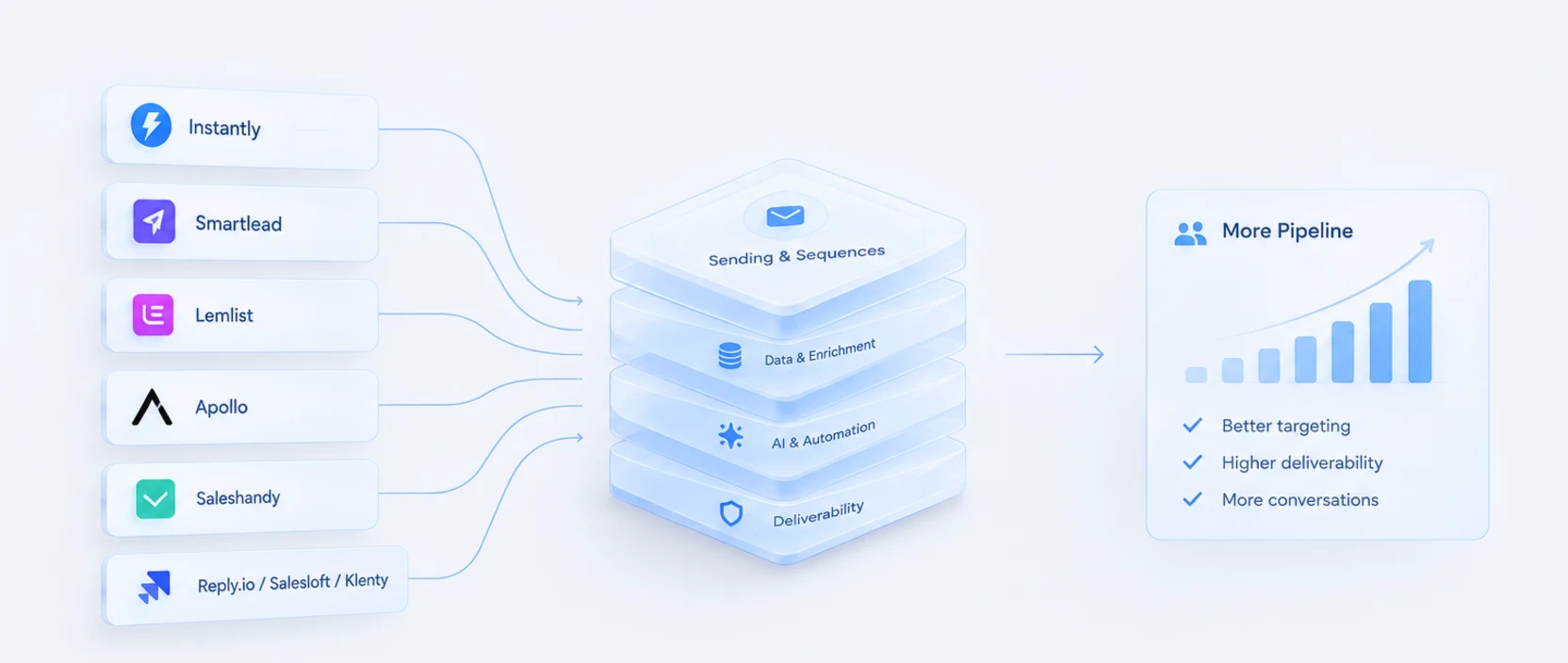
Instantly is the default cold email tool for a reason, but default is not the same as right for you. If you run an agency, send at serious volume, or need real multichannel sequences, there are alternatives that fit those jobs better. Here is the honest comparison, by what you are actually optimizing for, with real prices and real deliverability numbers rather than feature checklists.
One thing to settle first: none of these tools saves a bad sending setup. Deliverability discipline decides your results more than the logo on the dashboard. We will come back to that, because it is the part that actually matters.
The quick comparison
| Tool | Best for | Pricing | Deliverability note |
|---|---|---|---|
| Instantly | Founders and small teams | ~$47 to $555/mo, 450M+ leads + light CRM | 78-85% inbox placement; shared warmup pool |
| Smartlead | Agencies and high volume | ~$39 to $379/mo, strong API, white-label | 78-85% placement; SmartServers add-on for control |
| Lemlist | Multichannel and personalization | $63 to $109/user/mo | ~62% placement |
| Apollo | All-in-one data plus sending | $49 to $119/user/mo (free tier) | 275M contact database built in |
| Saleshandy | Budget | from $25/mo, unlimited accounts + warmup | sender rotation included |
| Reply.io / Salesloft / Klenty | Full sales engagement | varies, seat-based | multichannel: email, LinkedIn, calls, SMS |
Instantly vs Smartlead: the real fight
Most “Instantly alternative” searches are really Instantly versus Smartlead, so start there. On paper they are close: both offer unlimited warmup and mailbox rotation, and independent testing puts both in the 78 to 85% inbox placement range, well ahead of Lemlist’s roughly 62%. The differences are underneath.
Instantly runs public tiers from about $47 to $555 a month, bundles a database of 450M+ leads and a light CRM, and warms through a 4.2M+ account network. It wins for solo founders and small teams on interface and the built-in lead database, so you can prospect and send in one place.
Smartlead runs from about $39 to $379 a month, leans on a strong API and white-label options built for agencies, and uses AI-driven warmup plus its SmartServers feature for more granular reputation control. Its placement testing is a paid add-on, reported at roughly $49 to $599 extra. It wins for multi-client agencies on workspace isolation, API depth, and master-inbox operations, and for anyone sending at high volume where deliverability control is the priority.
One field note worth knowing: operators consistently report 30 to 40% open-rate drops on Instantly’s shared warmup pool, which is exactly the kind of reputation-sharing risk that Smartlead’s SmartServers are designed to sidestep. If your volume is serious, that difference is the whole decision.
The rest, by job
Lemlist built its name on personalized images and dynamic variables, then grew into a full multichannel sequencer across email, LinkedIn, and calling. Choose it when creative personalization and multichannel are the point, and accept the lower inbox placement as the tradeoff.
Apollo is the one to pick when you want the contact database and the sending in a single tool. Its 275M contacts with email and phone data feed directly into its sequencer, which makes it strong all-in-one value, and it is why it shows up in the wider GTM stack as often as it does.
Saleshandy is the budget answer at around $25 a month with unlimited email accounts, warmup, and sender rotation included, which makes it a genuine option for teams starting out.
Reply.io, Salesloft, and Klenty are full sales engagement platforms rather than pure cold email tools. If you need real multichannel cadences with calls and SMS alongside email, they play in a different league than a sender, and cost accordingly.
The part that actually decides your results
Here is the operator truth that no comparison table shows: the tool is maybe a quarter of your deliverability outcome. The other three quarters are how you set up domains, authentication, warmup, and rotation, and how you keep complaint rates down. A team on Smartlead with a sloppy setup lands in spam, and a team on Saleshandy with a disciplined one lands in the inbox. In 2026 this matters more than ever, because failed authentication now means outright rejection rather than the spam folder, so the margin for a weak setup is gone. We cover the full build in cold email deliverability in 2026.
And the sending tool is only the execution layer of a working motion. The sequence structure decides your reply rate, covered in cold email sequences that get replies, and the intelligence that decides who to send to and when is the AI outbound layer on top. The tool sits in the middle of all that, it does not replace it.
We build and run cold email on these tools daily, and it is how we turned $600 of cold email into $115,500 in pipeline, the full breakdown is here. The tool mattered far less than the system around it.
The takeaway
Pick your Instantly alternative by the job: Smartlead for agencies and high-volume deliverability control, Instantly for founders who want data and sending in one clean tool, Lemlist for multichannel and creative personalization, Apollo for all-in-one data plus sending, Saleshandy on a budget, and a full sales engagement platform if you need calls and SMS in the cadence. Then spend your real effort on deliverability, because that is what decides whether any of them reaches the inbox. Choosing and wiring that stack correctly is a core piece of GTM engineering.
Sources:
- Instantly vs Smartlead pricing and databases (Instantly ~$47-$555/mo, 450M+ leads + light CRM, 4.2M+ warmup network; Smartlead ~$39-$379/mo, strong API, white-label, SmartServers, placement testing paid add-on ~$49-$599): https://www.scaledmail.com/blogs/instantly-vs-smartlead-comparison and https://instantly.ai/blog/instantly-vs-smartlead-lemlist-2026/
- Deliverability placement (Instantly and Smartlead 78-85% vs Lemlist ~62%; both support warmup and mailbox rotation; 30-40% open-rate drops reported on Instantly’s shared pool): https://instantly.ai/blog/smartlead-alternatives-pipeline-2026/ and https://www.scaledmail.com/blogs/instantly-vs-smartlead-comparison
- Best-for use cases (Smartlead agencies/scale; Instantly founders/small teams; Lemlist multichannel/personalized images; Apollo built-in 275M database + sequencing; Saleshandy cheapest from $25/mo unlimited accounts; Reply.io/Salesloft/Klenty full multichannel engagement): https://instantly.ai/blog/best-instantly-alternatives-outbound-sales/ and https://coldiq.com/blog/instantly-alternatives
- Lemlist and Apollo pricing (Lemlist $63-$109/user/mo; Apollo $49-$119/user/mo with free tier): https://www.miniloop.ai/blog/lemlist-alternatives and https://www.apollo.io/insights/data-enrichment-tools
- 2026 deliverability enforcement (failed authentication now means rejection, not spam folder): https://leadhaste.com/blog/email-deliverability-2026-changes
- Tidalstead result: internal case study (six-hundred-dollar-campaign, $600 cold email to $115,500 pipeline).