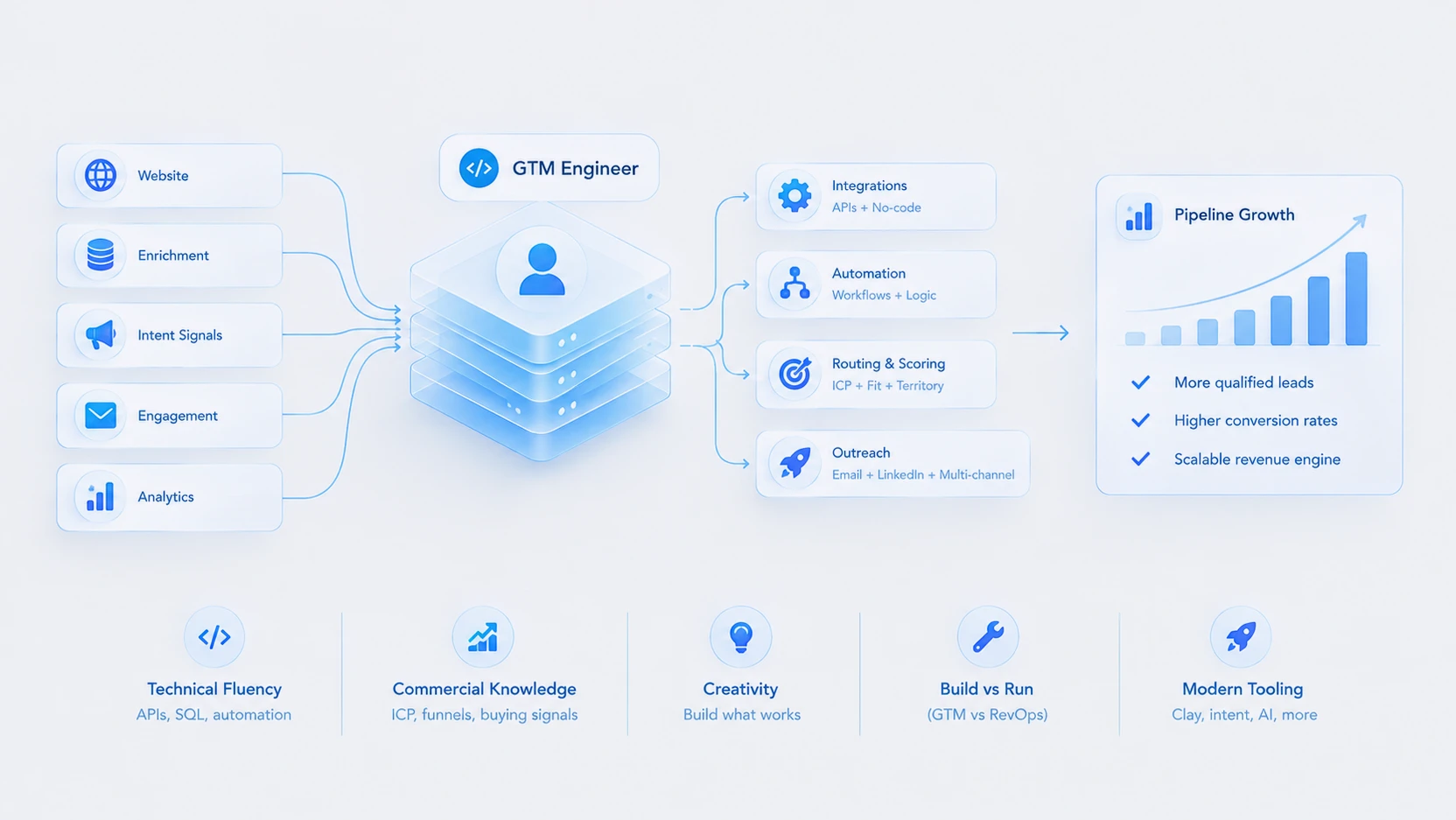
Two years ago the title barely existed. By January 2026 there were more than 3,000 GTM engineering roles posted on LinkedIn, up from around 1,400 in mid-2025, and hiring for the role has doubled year over year for two years running. That is not a rebrand of an old job. It is a new one, and it appeared because a specific set of tools made a new kind of work possible. Here is what a GTM engineer actually is, what they do, the skills the job demands, and why it exists now and not five years ago.
What a GTM engineer does
The one-line version: a GTM engineer makes revenue systems run like well-built software. The longer version is that they build, automate, and optimize the systems behind lead generation, sales intelligence, and customer acquisition, so those systems behave like an engineered product rather than a pile of disconnected apps.
Concretely, a GTM engineer keeps the CRM, enrichment tools, sales engagement platforms, and analytics working as one connected system. They write the API connections and no-code workflows that pass data between tools, so a signal in one triggers the right action in another. Enrichment that fires the moment a lead lands. A routing rule that assigns an account by fit and territory in real time. A buying signal that sets off a personalized outreach sequence automatically.
And the scope runs the whole funnel. GTM engineers own the systems that drive top-of-funnel demand, but also what happens after the lead arrives: routing, enrichment, scoring, nurturing, and conversion. It is systems work, applied to revenue.
The skills the role demands
The reason the role is hard to fill is that it sits across two worlds. Effective GTM engineers combine three things:
- Technical fluency to automate repetitive work: APIs and SQL, scoring-model design, workflow orchestration, and instrumenting a multi-stakeholder buyer journey.
- Commercial knowledge to know what to build: a real understanding of funnels, ICPs, and buying signals, usually from exposure to sales, SDR, marketing operations, or growth.
- Creativity to find what actually produces results, because most of the job is figuring out which system to build, not just building it.
Someone with only the technical half builds elegant workflows that do not move revenue. Someone with only the commercial half knows what should happen but cannot make the tools do it. The GTM engineer is the rare overlap, which is why compensation for the role runs strong, reported in the range of roughly $99,000 to $310,000.
GTM engineer versus RevOps: build versus run
This is the distinction that clears up most of the confusion. GTM engineers and RevOps people work on the same systems but do opposite jobs.
GTM engineering is about building new things from scratch. Net-new infrastructure, new automations, new signal-to-action systems.
RevOps is about running what exists. Optimizing, governing, and scaling the systems already in place.
Build versus run. A GTM engineer stands up the routing-and-enrichment system that turns a signup into a scored, routed lead in under a minute. RevOps keeps that system healthy, governed, and reported on over time. Both matter. They are not the same role, and a team that hires one expecting the other ends up disappointed.
Why the role exists now
New roles appear when the cost of some work drops sharply, and that is exactly what happened here. Clay, enrichment APIs, signal platforms, and AI coding tools dramatically lowered the barrier to building automation systems. Work that used to require an entire RevOps team, or a developer and a long backlog, became something a single skilled operator could do in an afternoon. Some describe the role as replacing three sales hires at once, which is less about headcount math than about how much one person can now build.
The category also had a moment. Clay introduced and reframed go-to-market as something you build, test, and improve rather than something you staff, and its June 18, 2025 “Rise of the GTM Engineer” manifesto is the marker most people point to for when the title went mainstream. An analysis of 1,000 GTM engineering job postings found Clay, HubSpot, and Outreach as the top three tools by employer demand, which tells you exactly what the work looks like day to day: orchestration across a data engine, a CRM, and an engagement platform.
What GTM engineering looks like in practice
The abstract definition gets concrete fast. Every one of these is GTM engineering:
- Building a system that enriches, scores, and routes a free-trial signup to the right rep in under a minute, covered in Clay enrichment and lead routing.
- Assembling the GTM and sales intelligence stack and wiring the layers so each feeds the next, while keeping enrichment cost per valid record under control.
- Standing up cold email deliverability as monitored infrastructure, then running signal-based AI outbound on top of it.
- Turning intent data into outreach that fires while the signal is still warm.
None of those is a tool you buy. Each is a system someone designs, connects, and maintains. That someone is a GTM engineer.
Why this is what Tidalstead does
Tidalstead is a GTM engineering team. We build these revenue systems and run them, and the infrastructure stays in your stack when we are done. It is how we screened more than 10,000 candidates a day across 120+ Fortune 500 roles, and how we turned $600 of cold email into $115,500 in pipeline. Both were systems, engineered, not campaigns run by hand.
The takeaway
A GTM engineer builds revenue systems that run like software: connecting the CRM, enrichment, engagement, and analytics into one machine where a signal triggers the right action automatically. They differ from RevOps in that they build net-new infrastructure rather than run existing systems. The role exists now because Clay, enrichment APIs, signal platforms, and AI collapsed the cost of building that infrastructure, so one operator can now do what a team once did. If you have a pile of GTM tools that do not talk to each other, what you are missing is not another tool. It is the engineering that turns them into a system.
Sources:
- Role definition (GTM engineer builds/automates/optimizes lead gen, sales intelligence, customer acquisition; makes revenue systems run like software): https://www.gofractional.com/blog/gtm-engineer and https://www.saleshandy.com/blog/gtm-engineer/
- Responsibilities (keep CRM/enrichment/engagement/analytics as one system; API + no-code workflows; signal triggers action; own routing/enrichment/scoring/nurturing/conversion): https://www.saleshandy.com/blog/gtm-engineer/ and https://www.apollo.io/insights/who-is-a-gtm-engineer-and-what-skills-do-they-need
- Skills (API/SQL, scoring model design, messaging architecture, journey instrumentation; sales/SDR/marketing-ops/growth exposure; technical + creative + commercial): https://www.apollo.io/insights/who-is-a-gtm-engineer-and-what-skills-do-they-need and https://www.anfloy.com/blog/gtm-engineer-skills
- GTM engineer vs RevOps (build vs run; net-new infrastructure vs optimizing/governing existing): https://www.salesforge.ai/blog/gtm-engineering-vs-revops and https://www.apollo.io/insights/gtm-engineer-vs-revops
- Rise of the role (hiring doubled YoY two years; ~1,400 LinkedIn postings mid-2025 to 3,000+ Jan 2026; comp ~$99K-$310K): https://pipeline.zoominfo.com/sales/gtm-engineer-hype and https://revnu.partners/blog/gtm-engineer
- Clay’s role (introduced/reframed GTM engineering; “Rise of the GTM Engineer” manifesto June 18, 2025; Bloomberry analysis of 1,000 postings found Clay/HubSpot/Outreach top 3 tools): https://www.clay.com/guides/gtm-engineering and https://www.thesignal.club/p/26-faqs-about-gtm-engineering-in
- Tools lowered the barrier so one operator does what a RevOps team did: https://pipeline.zoominfo.com/sales/gtm-engineer-hype and https://remotegrowthpartners.com/blog/what-is-a-gtm-engineer-the-emerging-role-thats-replacing-3-sales-hires-at-once