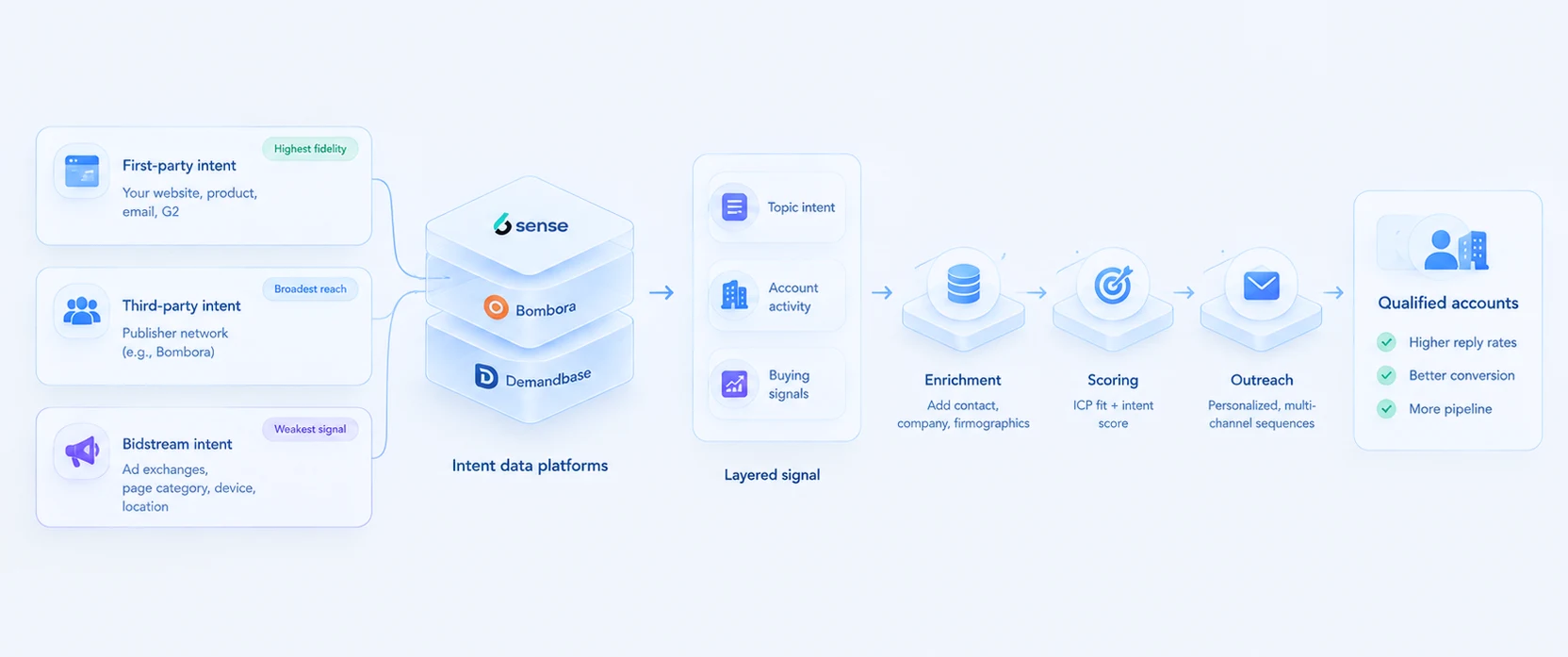
Intent data promises to tell you which accounts are in-market before they raise a hand. It is real, and it works, but with two caveats most vendor pages skip: it is directional, not proof, and the type of data matters far more than the logo on the platform. So before comparing tools, you have to understand the three kinds of intent data, because they are not equally trustworthy and they are not priced the same.
Here are the leading B2B intent data platforms in 2026, what each is for, and how to use them without overpaying for signal that does not hold up.
First-party, third-party, bidstream: the distinction that matters
All intent data is not the same data.
First-party intent is the signal captured from your own properties: your website, your paid landing pages, your email campaigns, your G2 profile. It is smaller in volume than the alternatives but far higher in fidelity, because the account is engaging with you specifically, not reading a random article somewhere. This is the highest-quality intent you can get, and it starts with knowing who is on your site, which is why it overlaps with website visitor identification.
Third-party intent tracks content consumption across a co-operative of B2B publishers. Bombora is the gold standard here and powers most of the category through its Data Cooperative of publishers and brand sites. It gives you breadth no first-party stack can match, a view of category-level research across a whole market, at directional rather than pinpoint accuracy.
Bidstream intent is auction-level data scraped via ad exchanges: page category, device, location, time. It is the cheapest and the weakest, because it is collected indirectly through an ad pixel rather than the page itself, and it does not by itself prove purchase intent. Consent-based co-op data is also legally defensible in a way bidstream is not. Treat bidstream as a loose hint, not a buying signal.
The rule of thumb: first-party for fidelity, third-party for breadth, and be skeptical of bidstream.
The leading platforms
The Forrester Wave named five leaders for B2B intent data: Intentsify, 6sense, Bombora, Informa TechTarget, and Demandbase. Here is what each is actually for.
| Platform | Best for | Data type |
|---|---|---|
| Bombora | The topic-intent backbone; breadth across the market | Third-party co-op |
| 6sense | Enterprise ABM with predictive scoring and ad activation | Third-party + predictive |
| Demandbase | Enterprise ABM leaning to programmatic advertising | Third-party + ad activation |
| Intentsify | Highest Forrester current-offering score; intent activation | Aggregated third-party |
| Informa TechTarget | Deep intent in technology and B2B tech buying | Publisher first-party at scale |
| G2 Buyer Intent | Seeing exactly who compares you against competitors | First-party (on G2) |
Two practical notes. Bombora is less a competitor to the others than the layer underneath much of the category, so many platforms are partly reselling or building on its co-op. And 6sense versus Demandbase, the two enterprise ABM leaders, comes down to whether you lean toward predictive analytics (6sense) or programmatic advertising (Demandbase). G2 is narrow but uniquely valuable: it shows the accounts actively comparing you to rivals, which is about as close to a buying signal as third-party data gets.
What intent data can and cannot tell you
Hold the whole category to an honest standard. Intent data tells you an account’s research behavior is elevated on a topic. It does not tell you they will buy, when, or from you. It is a prioritization signal, best used to decide who to reach out to now rather than to promise a deal. Teams that treat a Bombora surge as a qualified lead get burned. Teams that treat it as a reason to move an account up the queue, and then do real outreach, get the value.
The operator play: layer it, and act fast
Intent data only pays when you act on it, quickly, and the best setup layers the types rather than betting on one. Start with first-party, because it is the highest fidelity: your own website visitors, product signals, and G2 activity, captured through visitor identification software. Layer third-party like Bombora over it for market breadth you cannot see on your own site. Then the moment a strong signal fires, it has to trigger action, enrichment, scoring, routing, and outreach, which is the job of the routing engine and the AI outbound layer on top of it.
That end-to-end signal-to-outreach system is exactly what we build, including an intent-monitoring build that watched a marketplace for buying signals and turned them into outbound.
The takeaway
The best B2B intent data platform for you depends first on the type of data you need: first-party for fidelity, Bombora and the enterprise ABM platforms for third-party breadth, and treat bidstream as a hint rather than a signal. For enterprise ABM, 6sense and Demandbase lead. But the platform choice is the smaller decision. The bigger one is building the system that acts on a signal while it is still warm, because intent data that sits in a dashboard is just an expensive report. Turning it into pipeline is GTM engineering, and it is the work we do.
Sources:
- Forrester Wave leaders (Intentsify highest current offering, 6sense, Bombora, Informa TechTarget, Demandbase; 6sense/Demandbase enterprise ABM Gartner MQ leaders): https://www.cleanlist.ai/blog/2026-07-17-best-intent-data-providers and https://www.autobound.ai/blog/top-15-intent-data-providers-compared-2026
- First-party vs third-party (first-party smaller volume, higher fidelity; third-party = Bombora co-op, breadth, directional): https://www.intentdata.io/intent-data-blog/behind-third-party-intent-data-understand-the-source and https://learn.g2.com/b2b-intent-data
- Bombora Data Cooperative (gold standard third-party topic intent, powers the category): https://bombora.com/blog/7-types-of-intent-data/
- Bidstream data (auction-level, scraped via ad exchanges, does not prove purchase intent, not legally defensible like consent-based co-op): https://epom.com/blog/analytics/what-is-bidstream-data and https://www.intentdata.io/intent-data-blog/behind-third-party-intent-data-understand-the-source
- 6sense (predictive) vs Demandbase (programmatic advertising); G2 Buyer Intent shows who compares you to competitors on G2: https://www.cleanlist.ai/blog/2026-07-17-best-intent-data-providers and https://6sense.com/blog/top-demandbase-alternatives/